J
Jason Hitch
Time matters. When CPR is started and an AED is used within 3 to 5 minutes of cardiac arrest, survival rates can reach 60 to 70 percent.
Compliance counts. The Australian first aid code of practice expects accessible, appropriate and well-maintained first aid equipment.
Most failures are preventable. Expired pads, flat batteries and poor placement are among the most common AED issues.
Pads and batteries expire. Track dates religiously and replace consumables after any use and before expiry.
Register your device. Add your AED to state ambulance registries so Triple Zero operators can direct bystanders to it during emergencies.
Here's the uncomfortable truth: the AED sitting in your workplace corridor could be exactly what someone needs to survive a cardiac arrest, or it could be a very expensive paperweight with expired pads and a flat battery.
Most organisations buy an AED with the best intentions. They mount it in a cabinet, tick the compliance box, and then... forget about it. The device sits there, quietly aging, its battery draining month by month, its electrode pads slowly losing their adhesive quality. Nobody notices until the worst possible moment, when someone collapses and suddenly that green box everyone walks past becomes the difference between life and death.
The gap between owning an AED and having a rescue-ready AED comes down to maintenance. Not the complicated, time-consuming kind that requires a degree in biomedical engineering, just a simple, repeatable routine that takes less time than making a coffee.
This guide will walk you through exactly what AED defibrillator maintenance looks like in practice, why it matters more than most people realise, and how to build a checklist that actually gets followed.

Cardiac arrest doesn't send a courtesy email before it arrives. It happens suddenly, often without warning, and the clock starts ticking immediately. For every minute that passes without CPR and defibrillation, survival rates drop by roughly 10 percent. The Heart Foundation's guidance on using AEDs emphasises that early defibrillation, combined with effective CPR, can dramatically improve outcomes, but only if the equipment actually works when you need it.
By the time someone finds your AED, opens the cabinet, powers it on and discovers the pads are three years out of date, those critical minutes are gone.
There's also a legal dimension that often catches organisations off guard. The Australian first aid code of practice is explicit about workplace obligations: first aid equipment must be appropriate for the risks present, clearly visible, easy to reach and maintained according to manufacturer instructions. An AED that's locked away, poorly signposted or non-functional doesn't just fail to help, it exposes your organisation to compliance issues and, more importantly, betrays the duty of care owed to staff, students or visitors.
Common AED failures documented by WorkSafe WA include expired or missing electrode pads, flat batteries, devices hidden in locked cupboards, and lack of clear signage. The irony? Almost every one of these failures is preventable with a basic maintenance routine.
An AED is only as good as the condition it's in when needed. Regular checks aren't bureaucratic box-ticking, they're the difference between a device that saves a life and one that fails when it matters most.
Let's be realistic: nobody has time for a maintenance ritual that takes an hour and requires three different forms. The beauty of AED maintenance is that it doesn't need to be complicated. Five minutes a month, done consistently, will keep your device rescue-ready without disrupting anyone's workflow.
Here's what that looks like in practice:
Every AED has a visual readiness indicator, usually a green tick, light or symbol visible through the cabinet or on the device itself. If it's green and steady, you're good. If it's red, flashing, or making alarm sounds, the device has detected a problem and needs attention immediately.
When an AED shows a "not ready" status, it should be taken out of service and investigated according to the manufacturer's manual. Don't assume it'll sort itself out.
A simple wall-mounted checklist makes this easier. NSW Health provides a free AED maintenance checklist poster that can be printed and displayed near your device as a visual reminder.
Open the device and physically check that electrode pads and the battery are both present. This sounds obvious, but pads sometimes go missing after training sessions or when someone "borrows" them for another device.
Check the expiry dates printed on both consumables. Electrode pads are single-use and have a finite shelf life, typically two to four years. Batteries vary depending on the model, but they also expire and lose capacity over time, even if the AED hasn't been used.
If anything is due to expire within the next three to six months, order replacements now. Don't wait until the day before expiry when supply might be limited.
Most AEDs come with, or should have, a small rescue kit attached to or stored near the device. This typically includes:
Scissors (to cut clothing away from the chest)
A disposable razor (to shave hairy chests so pads adhere properly)
Alcohol wipes or towelettes (to dry wet skin)
Disposable gloves
A CPR face shield
These items might seem minor, but they're critical for preparing the chest quickly so electrode pads make proper contact. Effective defibrillation depends on good pad-to-skin contact, and chest preparation is a key part of the resuscitation process outlined in ANZCOR Guideline 7.
If anything is missing, replace it. Kits are inexpensive and take up minimal space.
Walk up to your AED as if you've never seen it before. Can you spot it easily? Is there clear signage directing people to it? Does the cabinet open without a key, code or struggle?
The Australian first aid code of practice emphasises that AEDs must be clearly visible and easy to access. A device hidden behind a locked door or buried under storage boxes might as well not exist.
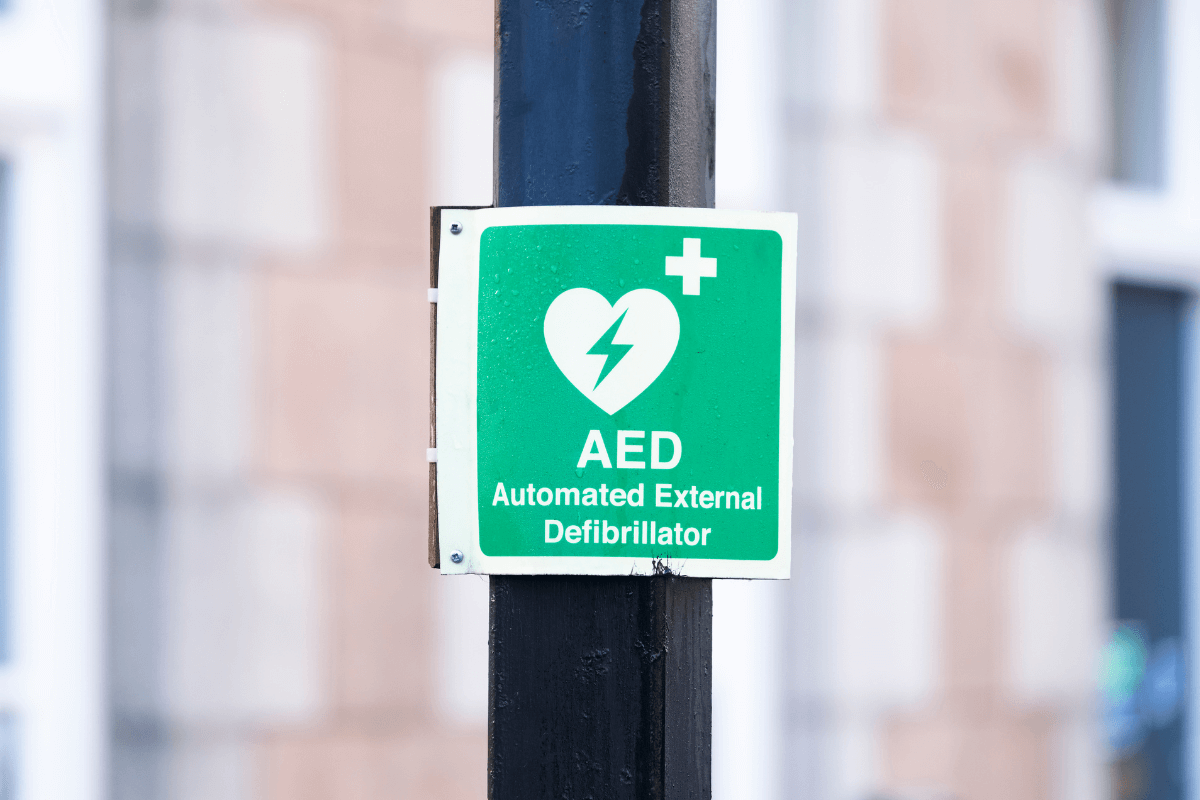
If your AED is in a communal area, make sure green-and-white AED signage is visible from multiple angles. If it's in a cabinet with an alarm, test that the alarm still works, it's meant to alert nearby people that the device is being accessed.
AEDs are robust, but they're not indestructible. Extreme temperatures, particularly heat, can degrade batteries and electrode pads faster than expected.
Check the manufacturer's manual for recommended storage temperature ranges (usually between 0°C and 50°C) and make sure your device isn't stored in direct sunlight, a hot vehicle, or anywhere subject to temperature extremes.
This is the step people skip, and it's the one that matters most when auditors or investigators come asking. Keep a simple log, either a printed sheet near the device or a digital record, that notes the date, who performed the check, what the status was, and whether any action was needed.
Initial the tag attached to the AED or cabinet. It takes five seconds and creates an audit trail that proves compliance.

Monthly checks keep the wheels turning, but once a year you need to go deeper. Schedule this into your calendar as a recurring task, ideally around the same time each year so it becomes routine.
Even if your monthly checks show everything is in date, use your annual review to order any pads or batteries due to expire within the next six months. This gives you a buffer for supply delays and avoids the last-minute scramble.
Be aware that specific AED models can be subject to safety notices or supply constraints. For example, the TGA issued a recall for certain HeartSine Pad-Pak batteries due to potential power issues, and market actions have also been taken for selected HeartSine Samaritan PAD devices. Before ordering, check the latest TGA safety notices to ensure you're not inadvertently purchasing affected stock.
For remote sites or high-risk environments, consider keeping spare pads and a backup battery on hand. The small upfront cost is nothing compared to the consequences of running out.
An AED is only useful if people know where it is and feel confident using it. ANZCOR Guideline 7 sets out the principles for automated external defibrillation as part of basic life support, and regular refresher training helps embed that knowledge.
Use your annual review to run a quick CPR and AED demonstration. Show staff where the device is stored, how to open the cabinet, and walk through the basics of turning it on and following the voice prompts. You don't need a full certification course, just a 15-minute refresher to demystify the device and build confidence.
Workplaces evolve. Floors get reconfigured, walls go up, storage areas shift. What was once a highly visible AED location might now be tucked behind a partition or blocked by new furniture.
The Australian first aid code of practice requires that AEDs remain clearly visible and accessible. Walk through your site with fresh eyes and ask: if someone collapsed here today, would a bystander be able to find the AED in under 60 seconds?
If the answer is anything other than "yes," move the device or improve the signage.
If you've moved your AED, changed building access hours, or updated contact details, make sure your state ambulance registry is updated.
Ambulance Victoria operates a Register My AED service, NSW Ambulance uses the GoodSAM platform for AED registration, and Queensland Ambulance Service offers its own AED registration portal. Registration allows Triple Zero call-takers to direct bystanders to nearby AEDs during emergencies, potentially saving critical seconds.
NSW Health provides additional resources and templates for organisations managing AED programs, which can be useful if you're coordinating multiple devices across different sites.

AEDs are designed for single-use deployment. Once electrode pads have been applied to a patient, even if no shock was delivered, they cannot be reused. The adhesive gel loses its effectiveness and the pads may be contaminated.
Here's what needs to happen immediately after use:
Replace the electrode pads. Open a fresh set and install them in the device. If you don't have spares on hand, take the AED out of service and order replacements urgently.
Check the battery and status indicator. Some AEDs automatically flag when the battery is low or when a post-use check is required. Follow the prompts in the manufacturer's manual and confirm the ready indicator is green before returning the device to service.
Restock the rescue kit. Replace any scissors, razors, wipes or gloves that were used. Clean the cabinet if needed.
Document the event. Record the date, time, location and circumstances of use. This creates a paper trail for compliance and helps identify patterns (e.g., if the same location has multiple incidents, you might need additional equipment or training).
Reset the device if required. Some models need a manual reset after use. Check your manual and make sure the unit is fully operational before it goes back into the cabinet.
The NSW Health AED maintenance checklist provides a useful template for post-use procedures and can be adapted to your organisation's needs.
This is one of the simplest, most impactful things you can do, and it's shocking how many organisations skip it.
When someone calls Triple Zero for a cardiac arrest, the call-taker can check a live map of registered AEDs and direct the nearest bystander to collect it while paramedics are en route. In regional or remote areas where ambulance response times might stretch to 15 or 20 minutes, a registered AED can be the difference between life and death.
Registering takes about five minutes and requires basic information: the device location, access hours, any entry codes or keys needed, and a contact person.
Ambulance Victoria's Register My AED portal covers Victorian sites
NSW Ambulance uses the GoodSAM platform for AED registration
Queensland Ambulance Service has its own registration system
The GoodSAM network connects emergency services with nearby responders and registered AEDs, creating a community safety net that extends well beyond your organisation's walls. If your state or territory isn't listed above, check your local ambulance service website for registration options.
Even well-intentioned organisations fall into predictable traps. Here are the most common ones:
This is the number one AED failure mode. Consumables expire, and if you're not tracking dates, you won't notice until it's too late.
Solution: Set calendar reminders six months before expiry. Keep a spreadsheet or use a maintenance app that flags upcoming expirations. Order replacements early, don't wait until stock is running low.
An AED locked behind a door that requires a key or swipe card is effectively inaccessible during an emergency. Even cabinets with alarms need to be easy to open, seconds matter.
Solution: Use breakable glass or push-to-open cabinets that trigger an alarm when accessed. Make sure the cabinet mechanism works smoothly and doesn't jam.
If people don't know where the AED is, they won't use it. This is especially common in large buildings, schools or shopping centres where devices are installed but never properly signposted.
Solution: Install clear, illuminated or highly visible green-and-white AED signs at multiple points, not just at the cabinet itself. Use directional arrows if the device is around a corner or down a corridor.
Electrode pads need clean, dry skin to adhere properly. If the patient has a hairy chest or is wet (from sweat, rain or a pool), pads won't stick and the AED won't deliver an effective shock.
Solution: Always keep a disposable razor and alcohol wipes in or near the AED. Check these during your monthly inspection and replace them if they're missing or dried out.
Here's something most organisations don't think about until it's too late: AED consumables are not always readily available.
Supply chain issues, product recalls and manufacturing delays can all restrict access to pads and batteries for specific models. Recent TGA recalls affecting HeartSine Pad-Pak batteries and market actions involving certain HeartSine Samaritan PAD devices are reminders that even established brands can face supply constraints.
The solution is simple: plan ahead. Order consumables at least six months before expiry, and consider keeping a spare set of pads on hand, especially for remote sites, high-risk environments, or facilities with limited access to suppliers.
When ordering, check that your supplier has stock available for immediate dispatch rather than extended lead times. The last thing you need is a six-week wait when your pads are expiring in two weeks.
Once you've built your maintenance checklist and locked in your routine, the next challenge is making sure procurement doesn't become a bottleneck.
LFA First Response stocks a comprehensive range of AEDs, genuine batteries, electrode pads and accessories, with fast dispatch across Australia and free delivery on orders over $350. Whether you're replacing consumables for an existing device or upgrading to a newer model, you'll find what you need without the usual supply delays or stock shortages that have plagued the market recently.
For example, the Mindray C1A fully automatic defibrillator combines ease of use with clear voice prompts and automatic shock delivery, making it ideal for workplaces where non-medical staff will be the first responders. Pair it with a defibrillator wall cabinet with alarm to improve visibility and ensure people nearby are alerted when the device is accessed.
You can browse the full range of defibrillators, batteries and accessories, and cabinets and signage online, and if you're unsure which model suits your site or need advice on consumables, the team is on hand to help.

Your AED is not a set-and-forget purchase. It's a piece of life-saving equipment that requires a small, consistent investment of time to remain effective.
Think of it like a smoke alarm with superpowers: it sits quietly on the wall, hopefully never needed, but absolutely critical when the moment comes. A five-minute monthly check, an annual deep dive, registration with your state ambulance service, and ordering ahead of expiry dates, that's all it takes to keep your AED rescue-ready.
The alternative is discovering, in the worst possible moment, that the device you relied on isn't ready. That the pads are expired. That the battery is flat. That the cabinet is locked and nobody can find the key.
You don't want that moment. Nobody does.
So build the checklist. Set the reminders. Do the checks. Register the device. And when the time comes, if it ever comes, your AED will do exactly what it was designed to do.
Explore LFA's range of AEDs and accessories available for immediate dispatch.

In this guide, you will learn all about the Australian mining site first aid requirements, including equipment and facilities for different remote operations.
J
Jason Hitch

Learn how to choose the right workplace defibrillator based on your environment, workforce, compliance needs, maintenance and on-going AED support in this guide.
J
Jason Hitch
What should a marine first aid kit contain? In this guide, discover 10 essential items for Australian boats, plus practical storage and preparation tips.
J
Jason Hitch

Looking for workplace stretcher that suits your industry? Compare types, safe working loads, environments and key features to make an informed choice.
J
Jason Hitch